- Los chatbots brindan respuestas programadas, mientras que los agentes virtuales pueden entender lo que quieren decir las personas y tomar medidas, como programar citas.
- Los agentes virtuales trabajan en el chat, la voz, el correo electrónico y los SMS. Se conecta con herramientas como el CRM o el calendario, lo que automatiza los flujos de trabajo.
- Si necesita algo más que una simple sesión de preguntas y respuestas, un agente virtual suele ser la mejor opción a largo plazo.
If you’ve started looking for ways to automate customer conversations, you’ve probably come across terms like chatbots, virtual agents, AI assistants, and conversational AI. They might sound the same, but there are some important differences, and it’s worth knowing which is which, especially when you’re deciding where to spend your time and money.
Here’s the easy way to remember it:
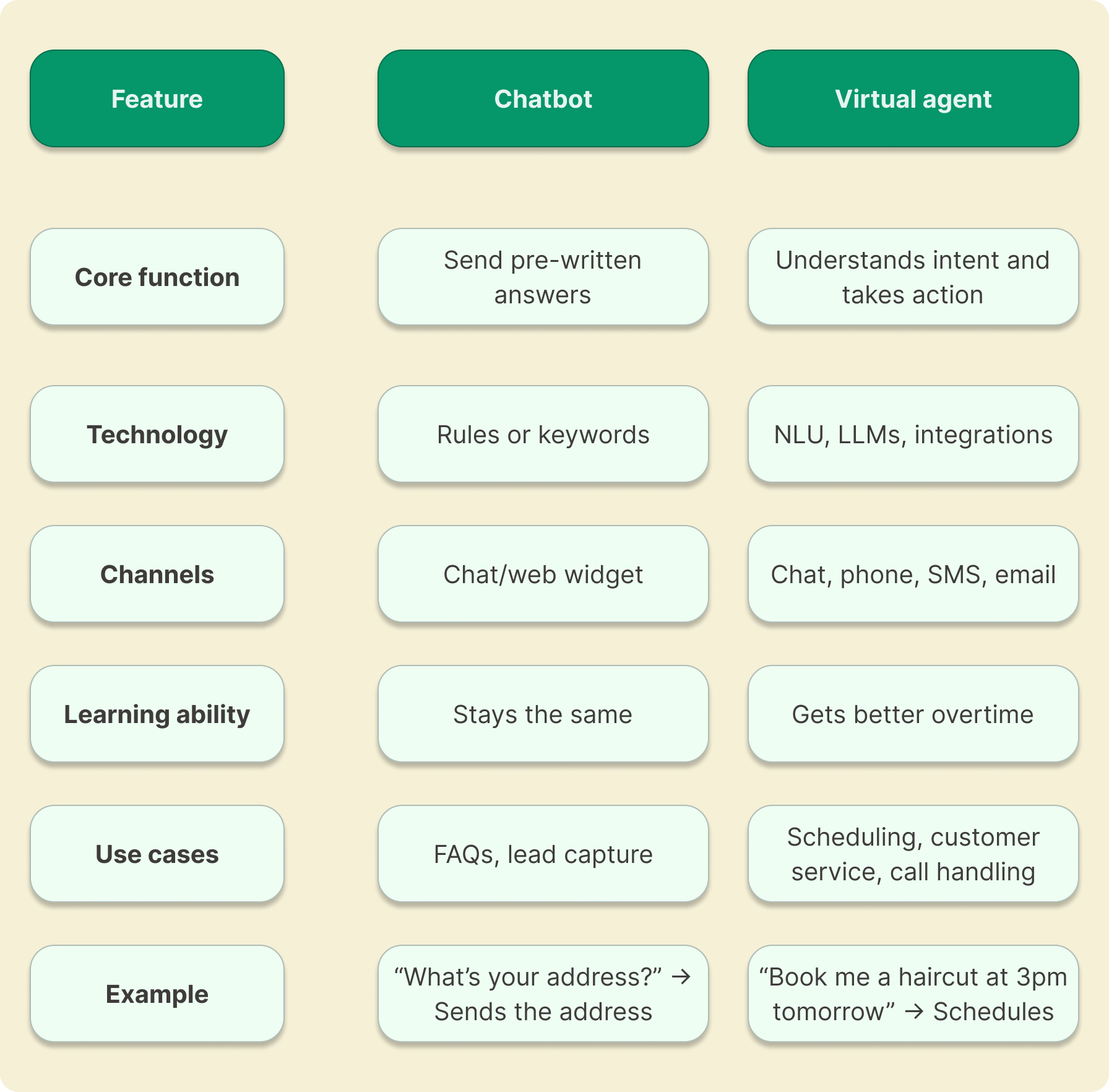
A chatbot gives pre-written answers based on set rules or keywords.
A virtual agent (or AI agent) can understand natural language and actually do things for your customers—like booking appointments, updating info, or transferring calls.
In this guide, we’ll explain what each one does, where they overlap, and how to pick the best fit for your business.
What is a chatbot?
A chatbot is a tool that chats with your customers by using pre-written messages and keywords. Think of it like an automated FAQ that sits on your website, ready to help with common questions.
How it works
Let’s say someone types, “What are your store hours?” The chatbot looks for the word “hours,” then sends back the answer you already set up. Some chatbots can recognize similar questions thanks to basic machine learning, but they’re still limited to what you’ve programmed them to say.
Best for
- Answering common FAQs
- Collecting leads (like, “Can I get a quote?”)
- Simple, straightforward conversations
Limitations
- Can’t answer complex or open-ended questions
- May get confused if a customer phrases something differently
- Can only provide information, not take actions
If your customers just want quick answers, a chatbot does the job. But if they need to get something done, you’ll want to look at virtual agents.
What is a virtual agent (or AI agent)?
A virtual agent is a more advanced system that understands what your customer is asking and can help them get things done. It uses natural language understanding (NLU) and large language models (LLMs) to figure out intent, not just keywords.
How it works
Imagine a customer says:
“Can you move my appointment to tomorrow afternoon?”
A basic chatbot might not know what to do. But a virtual agent will:
- Recognize the customer wants to reschedule
- Check your calendar for available times
- Book the new appointment
- Send a confirmation by text or email
In short, it doesn’t just reply with the same responses. It actually takes action, like scheduling an appointment or sending a follow up text.
What makes virtual agents powerful
- Understands real conversations, not just commands
- Connects with tools like CRMs, calendars, and ticketing systems
- Can handle voice, SMS, chat, and email, not just website chat
- Gets smarter over time as it learns from real interactions
Virtual agents can answer calls, book appointments, route messages, and even summarize conversations for your team.
Virtual agent vs chatbot: side-by-side comparison
When to use a chatbot
A chatbot is a great place to start if you want simple automation and your needs aren’t too complex.
Use a chatbot if:
- You get lots of the same, repetitive questions
- You don’t have the time or resources to set up integrations
- Your main goal is to cut down on basic support requests
Chatbots are affordable, quick to set up, and often come with website builders or basic CRM tools. They’re an easy first step, but they have limits when customers want more natural, helpful conversations.
When to use a virtual agent
Virtual agents are best when you want automation that feels personal, and can actually help your customers get things done.
Use a virtual agent if:
- You’re getting a lot of chats or calls
- Customers are asking to book, cancel, or check on something
- You need 24/7 or multilingual support
- You’re missing out on leads when your team is busy
Virtual agents are especially helpful for businesses that book appointments or rely on phone calls, like veterinary clinics, law firms, property managers, or home service companies.
Instead of asking customers to wait on hold, a virtual agent can help them right away, even after hours.
The trend: from chatbots to real AI agents
The difference between chatbots and virtual agents is getting bigger. Modern AI agents don’t just reply, but they can understand what your customers want, plan multi-step tasks, and work across your different software tools. Some can even answer the phone, greet customers, check details, and transfer them to the right person all on their own.
You’ll see these capabilities in tools like Zoom Virtual Agent or AI answering services that manage both voice and chat.
This is the next step in automation: moving from simple bots that reply to smart agents that take action.
Popular AI virtual agent services (and what they handle)
If you’re exploring options, here are a few examples of modern virtual agent platforms and what channels they cover today:
Phone & call handling: Upfirst
Upfirst is built for small businesses that can’t always answer the phone.
It acts as a 24/7 AI answering service, like greeting callers, routing them to another person or department, booking appointments, and sending instant call summaries to your email or phone.
It’s designed to be an affordable answering service for contractors, law offices, real estate agents, and local businesses that need help answering phone calls without hiring staff around the clock.
Example: A caller says, “I'd like to schedule an appointment.”
Upfirst checks your Google Calendar, offers available times, and books the appointment in your calendar.
Website & live chat: Intercom Fin + Ada
Platforms like Intercom’s Fin and Ada extend beyond basic chatbots.
They let businesses deploy AI virtual agents that can understand customer intent, connect to back-end systems, and execute tasks like order lookups, account updates, or refund processing, all within the chat window.
Fin, for example, pulls verified answers from your documentation or knowledge base instead of guessing, and relays them in a natural way.
SMS & text messaging: Bland AI
Bland AI brings AI virtual agents to SMS and phone conversations.
It allows businesses to automate two-way texting with customers, confirming appointments, sending follow-ups, collecting information, or handling customer questions directly through text.
The platform focuses on real conversational understanding, so messages sound natural and stay on-brand.
Example: A customer texts, “Can I get a quote for pest control?”
Bland AI’s agent replies conversationally, collects details, and sends the estimate automatically, without a human ever typing a response.
Email & helpdesk: Salesforce Einstein + Zendesk AI
Tools like Salesforce Einstein Bots and Zendesk AI are evolving into full virtual agents that handle email threads and support tickets.
They can summarize long customer emails, suggest replies for your team, or even auto-resolve certain cases by recognizing intent (like “cancel my subscription” or “update my address”).
Cómo decidir: un marco rápido
Hágase estas tres preguntas:
- ¿Necesito algo más que respuestas escritas?
- ¿Debería mi sistema poder hacer cosas (como reservar, comprobar o actualizar)?
- ¿Estoy gestionando tanto el chat como las llamadas telefónicas?
Si respondió «sí» a la mayoría de estas preguntas, un agente virtual es probablemente su mejor opción. Si no es así, un chatbot podría ser todo lo que necesitas por ahora.
En pocas palabras
Los chatbots dan respuestas. Los agentes virtuales hacen las cosas.
Si desea ir más allá de las preguntas y respuestas básicas y ofrecer una experiencia más humana y útil, al tiempo que automatiza el trabajo arduo, un agente virtual es la mejor opción.
Preguntas frecuentes
¿Un agente virtual es solo un chatbot más sofisticado?
La verdad es que no. Los chatbots responden a preguntas sencillas, mientras que los agentes virtuales pueden gestionar las tareas, conectarse con sus herramientas y gestionar las solicitudes más complejas.
¿Los agentes virtuales pueden gestionar las llamadas telefónicas?
Sí, muchos agentes virtuales modernos pueden responder llamadas, recibir mensajes, reservar citas y transferir llamadas mediante la voz.
¿Necesito saber cómo programar para configurar uno?
La mayoría de las plataformas actuales permiten configurar y personalizar agentes virtuales sin necesidad de programar. Por lo general, puede cargar sus preguntas frecuentes o conectar su calendario y su CRM con solo unos pocos clics.
¿Qué sectores utilizan agentes virtuales?
Los centros de atención médica, legal, de administración de propiedades, de servicios domésticos, de comercio electrónico y de soporte utilizan agentes virtuales para gestionar el trabajo repetitivo y liberar a sus equipos para que puedan dedicarse a tareas de mayor valor.
¿Los agentes virtuales son caros?
Al principio, pueden costar más, pero a menudo se amortizan ahorrando tiempo y ayudándote a captar clientes potenciales que de otro modo te habrías perdido.

Nick Lau is a copywriter and content lead for Upfirst.ai. A self-starter at heart, he dove into marketing in 2015 by launching an e-commerce company, selling private-labeled products on Amazon and Shopify. When he’s not crafting copy, you might spot him on a winding road trip to the coasts or through forests, in search of unexplored places.